Sunday, March 20, 2022

The Transforming Power of the Cross


Transforming a lifestyle into a lovestyle by the transforming power of the cross of Christ


A Lenten Reflection for the 3rd Sunday of Lent
By Fr. Maximilian Buonocore, OSB

Introducing the Penitential Rite

I searched the internet for a good Lenten diet. I found the perfect Lenten diet: It's a five-course meal: (1) Eat your words, (2) Swallow your pride, (3) Digest God’s Holy Word, and, (4) For dessert, indulge your appetite for prayer and meditation. (5) This Lenten meal is always begun with the holy appetizer of repentance of heart. What a menu for Lent! This daily meal is only be completed worthily by engaging in loving service. Let us begin our five-course Lenten meal today with the holy appetizer of repentance of heart, ruminating on our sins and confessing them to the Lord.

Manifestations or interruptions?

One of the world’s most popular comic strips is Hagar the Horrible. In one strip we find Hagar kneeling in prayer. “It’s not easy to believe in you, God. We never see you. How come you never show yourself? How do we know you even exist. . .” Then in the next few frames we see a flower springing into life beside Hagar, a volcano erupting in the distance, an eclipse of the sun turning the sky black, a star shooting across the stratosphere; a tidal wave rushing over Hagar, lightning flashing, a bush burning and not being consumed, and finally, a stone rolling away from the entrance to a tomb. In the last frame Hagar is pulling himself from the mud, dripping wet, surrounded by darkness, saying. “OK, OK. I give up! Every time I bring up this subject, all we get is interruptions.” Perhaps this is why we, too, miss opportunities for encounter with the Lord. The things that we often consider as interruptions of our encounter with Christ are actually the very occasions of encounter. By considering them interruptions, we miss the encounter. One of the images in that cartoon was the image of a bush burning without being consumed: a reference to the burning bush from which the Lord communicated with Moses. It made me realize that God is frequently, throughout every day, making his presence felt, giving me opportunities of encounter with him, communicating with me from a burning bush: the bush of every fellow human being that I come in contact with. Each human being is a burning bush, burning with the flame of the image and likeness of God in them, burning but not consuming. It made me realize that I am standing on holy ground whenever I encounter a fellow human being, especially when I encounter a fellow human being in need. That person is a burning bush through which God is communicating his love to me and commissioning me to convey that love to others, to deliver others from their consuming sufferings. So many people, though the flame of the Spirit of love burns within them without consuming, yet they are being consumed by the combustive energy of sin. I am called to help to deliver God’s people from this enslaving and consuming force. Through the burning bush of my neighbor, God is challenging me to lead his people through the red sea of suffering into a land of the milk and honey of grace and charity.

The last time I talked to a Bush

President George Bush was speaking at a rally. As he was speaking he saw someone in the crowd who looked just like Moses. When the rally was over, he didn’t want to miss the opportunity to meet such a well-known biblical celebrity. So he quickly made his way over to the man and said, “Are you Moses?" He didn’t say anything and just walked away. Bush then told his security agents to go over to interrogate the man. His lead security agent went over to the man and said, "With the beard, the cloak, the staff, the wrinkled skin... you look exactly like Moses." Moses replied, "That is because I am Moses." Confused, the security agent asked, "Why didn't you just tell the President that then? What harm could it have caused?" “Well,” replied Moses, "The last time I talked to a Bush, I was stranded in a desert for 40 years." God asked Moses to lead his people into the wilderness where they sojourned for 40 years because it was in the desert where the Lord was able to transform the Israelites lifestyle - the lifestyle that they learned during their 400 years in Egypt - from a lifestyle into a lovestyle. That is what the 40 years in the wilderness was about - a transformation of a lifestyle into a lovestyle. The Lord said to Moses, “I have witnessed the affliction of my people in Egypt and have heard their cry of complaint against their slave drivers, so I know well what they are suffering.” This is a message of love - the love of a Father for his children - the love that feels the suffering of the beloved. Yet his beloved children were not responding to that love. Their lifestyle prevented them from responding to love with love. He needed to transform their lifestyle into a lovestyle. That is the purpose of our 40 days of Lent, commissioned by God from the burning bush of our humanity, to allow the Lord to transform our lifestyle into a lovestyle.

A Lifestyle is what you pay for. A life is what pays you.

Recently, I got the following fortune in a fortune cookie: “A lifestyle is what you pay for; a life is what pays you.” It got me thinking about the difference between lifestyle and life. A lifestyle is the sum total of all of the work, recreational, social and religious activities that one engages in daily. It includes the use of many things that are paid for to acquire or to engage in, including education and training, transportation, all kinds of devices, utilities, rent and mortgage payments for facilities, etc. But life is not paid for. Life is a gift. This makes me think of an episode with my students. One day two of my students were having an argument. After yelling at each other for a while, one of them said to the other, “Get a life!” The other responded, “Can you get me a gift card for that.” “I don’t know,” said the first, “is it expensive?” A lifestyle can be expensive, but when we live life according to the highest level of our calling as human beings, we will not be paying: life will be paying us from the hidden store deep within us - the store which flows from the image and likeness of God in us; the store of the Spirit of love that dwells in us. This flow of love - this gratuitous divine-life-payment - may, in fact, result expenditure of economic and human resources on our part, but the expenditure will be more directed to community building and support of the life the community to which I belong, and less directed to self-building and support of my own life primarily. Our lifestyle is transformed into a love-style. What we will be expending will be expended more from self-sacrifice in the service of love, rather than in the service of self-advancement and self-interest. That is what Lent, and the perpetually Lenten life of the Christian, is all about: through prayer, abstinence, and self-sacrificial service, constant decreasing of my investment in lifestyle, while constantly increasing my investment in life - that is, the constant increasing of my freedom from the self-centered demands of lifestyle in order for God to be ever increasingly able to invest true life - that is, divine life - in me, and, through me, to invest his divine life - his divine love - in the world. Lent is about God paying us - making a personal investment in us - and the Lenten exercises clear our accounts payable of worldly expenses and make our accounts receivable ever more to his divine payments of grace and of love. And this all happens by the transforming power of the Cross of Christ encountered in and through the burning bush of my fellow suffering human beings.




Sunday, January 2, 2022

Look Towards the Manger and Be Radiant With Joy


Look Towards Him And Be Radiant With Joy

Poetic Reflection based on Colossians 1:15-20 and Psalm 34:6
By Maximilian P. Buonocore, OSB

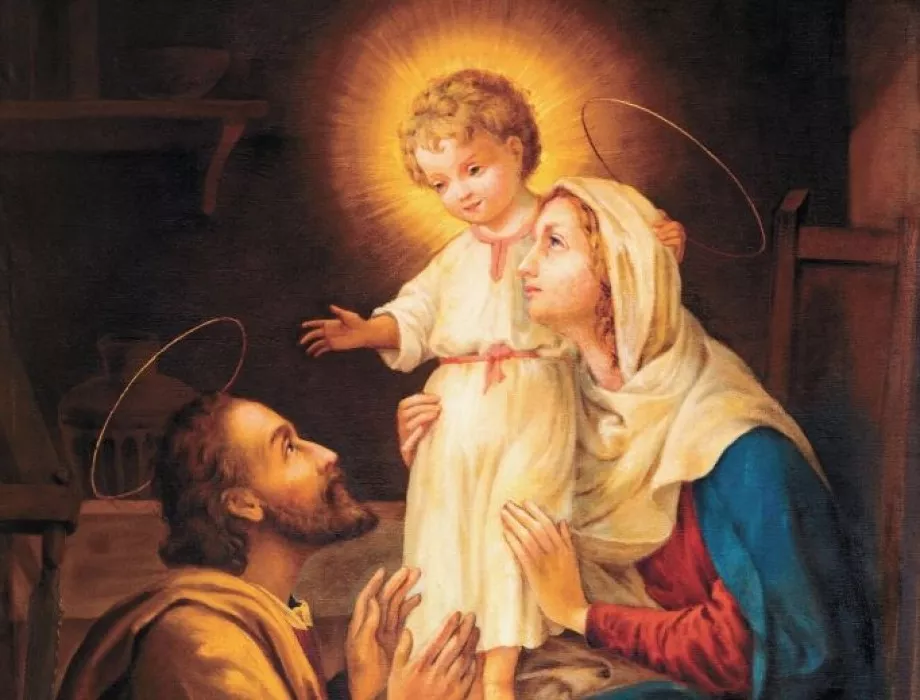
Through the eyes of faith, I look at the child in the manger and I see, the one who is the image of the invisible God, the firstborn of all creation. Through the eyes of hope, I gaze at the infant in swaddling clothes, and I behold, the one in whom were created all things in heaven and on earth. 
Through the eyes of love, I look upon the babe that the Blessed Mother holds at her breast, and I see, the one who is before all things, and in whom all things hold together. By the light of faith, I see in that newborn, the one who is the head of the body, the church. By the power of hope, I behold in that little one lying in a manger, the one who is the beginning, the firstborn from the dead. And by the power of love, I come and bow down at that manger altar, and I worship that infant, in whom all the fullness of deity is pleased to dwell, and through whom the Father is to reconcile all things for himself, making peace by the blood of his cross.

For the child born today is the bearer of joy.
He is born from eternal love, this little boy.
Look towards him, and be radiant with joy.
Look into his eyes and see the light
The light of a Father’s gaze so bright
Who looks down to earth from heav’nly height.

Infinite and eternal is his gaze of love.
The generating light that begets a Son above
Who in turn generates with the Spirit a Dove
Generates us children as thanksgiving gifts
To the Father in heav’n whose wisdom lifts
Each one of us heav’nward upon the Swifts.
This infant in the manger a heav’n descent
In bodily form a divine advent
To regenerate man by God’s assent.
For the child born today is the bearer of joy.
He is born from eternal love, this little boy.
Look upon him, and be radiant with joy.

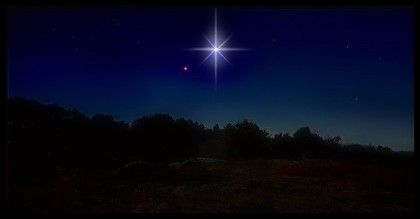
I followed the star to that manger bed
By the guiding light of wisdom led
I fall prostrate before like one who’s dead.
How could this be: A birth? A death?
A dying that yields the Spirit’s breath:
Death gives life, a child divine breath?
In an infant I found a love so great
Love surpassing life in this earthly state
Yes, dead am I before love so great.
I carry this death within my soul
A death, a longing with an endless goal
Unfathomably drawn to a celestial pole.
For the child in that manger is the bearer of joy.
He is born from eternal love, this little boy.
Look towards him, and be radiant with joy.

A royal son, anointed by chrism of myst’ry
An heir of humanity, a birth of divinity
Reborn in this birth, I find a vict’ry.
Look into the eyes of this babe agaze
Look into the eyes of heav’n ablaze
Look into the eyes of endless days.
A child is born the Angels sing
Glory in the highest with outstretched wing
Glad tidings to humankind they bring.
For the child in that manger is the bearer of joy.
He is born from eternal love, this little boy.
Look towards him, and be radiant with joy.

All for Jesus,
Fr. Max

The Manger of My Heart


Jesus Desires to be Born in the Lowly Stable of a Humble Soul
Christmas Reflection by Fr. Maximilian Buonocore, OSB

It was the night of the Christmas Nativity play. Johnny went to the auditions a few weeks earlier feeling very confident that he would get cast for the part of Joseph. He felt that he was best qualified for that major part. He was therefore very upset when he was, instead, cast for the minor part of the innkeeper. He was still feeling annoyed when the play started, and, as a result, when the time came, he didn’t remember his one line. When Joseph and Mary arrived at the inn and asked him, “Is there room in the inn?” Little Johnny, the innkeeper, quickly replied, “Sure, come on in!” The boy playing Joseph, knowing that he and Mary were not supposed to stay in the inn, but were supposed to end up in the stable, thinking quickly, looked around and said, "Nah. This place is a dump. I'd rather stay in the stable." Then turning to Mary he said, “Come on, Mary, let’s go to the stable.” Our soul can be like the inn where Jesus prefers not to stay. Jesus prefers not to stay in the inn adorned with vainglorious decorations of selfish ambition, and the comfortable bed of self-serving contentment; with a bar where one can consume the spirits of jealousy, envy and anger, then go to one’s room of isolating grudges to rest on one’s pillow of self-satisfying judgment and self-justification. Jesus prefers to stay in a soul that is a humble stable, in the manger of a pure heart.

THE MANGER OF MY HEART
Poem by Fr. Maximilian Buonocore, OSB

Behold, a star with heav’nly light
Shines forth from deep within me.
It beckons me to Bethlehem
The House of God within my soul;
To the Place of Incarnation
To the Place of Divine Begetting Love,
The Place of Creative Love, of Charity.

It’s light, now faint, now bright:
The goal of this alluring light,
The path to where it beckons,
Mountains and hills confront, oppose,
Rough streets and winding roads
Countervailing valleys to traverse.
Mountains of pride, hills of greed,
Valleys of sadness and of grief,
Anxiety winds the roads
Made rough by anger and offense.

But I travel defiantly on that opposing path
Eyes fixed in contemplation of alluring light,
The paternal light of Divine Remembrance,
Drawing me with Divine Compassion
An Infant to embrace: a King.
Alas, with lively prayer, I come!
Before the throne of a King I stand
With gold of humble self-sacrifice,
With the frankincense of praise,
Offering myrrh of deep compassion
Before a Newborn King’s throne:
The manger of my heart.

Behold!
Even those interior mountains and hills,
Once opposing, dance with joy!
Valleys of mourning and sadness shout
Their rejoicing at the sight,
Exulting in the presence,
In the Bethlehem, in the stable of my soul
The place where Incarnational Light
Conceives, gives birth, and rests a child,
A King, in the manger of my heart.

Come, O my dear Father, place
In the humble stable of my soul
The dearest infant Jesus
In the manger of my heart.
My Father looks forth from heaven
'Tis a wondrous sight to see,
He gazes upon his work of art
In the humble stable of my soul:
The place where baby Jesus rests,
The manger of my heart.

Come, O Holy Spirit, plant
The seed of life within my soul;
Come, O Holy Spirit, plant
The seed of love within my heart.
A flame descends from heaven
'Tis a wondrous vision to behold,
A seed of fire: a spark
In the humble seedground of my soul,
And a Mystical Child is conceived
In the womb of my heart:
The Child of Life, the Child of Love,
Infant wisdom: faith,
Filial reverence and expectation: hope,
Charity: the olive branch of divine love!

Yes, dear infant Jesus, rest
In the manger of my heart.
My soul is not a palace, blest
With gold and precious art.
It is a humble stable where
The beasts of burden dwell;
The beasts that bear the yoke so dear
Of meekness and humility, and till
The soil of the spirit for
The seeds of holiness to plant
On fertile ground so rich in grace
For Jesus’ love to grow, and grant
Fruit of kindness and of charity
To all the poor and needy, who
Are naked and cold, hungry and thirsty
Like you, O infant Jesus, too.
So feed ye beasts of burden
From the manger of my heart,
'Tis filled with grain of life, and in
Its depths the living waters start
To flow to life eternal;
For there lies the Child of Life
In the manger of my heart.

A star shines forth from heaven
'Tis a wondrous sight to see.
It shines upon this work of art.
The place where baby Jesus rests
In the humble stable of my soul:
The manger of my heart!

All for Jesus,
Fr. Max


Being Members of a Royal Family


We Are Members of the Extended Family of Christ
Reflection by Fr. Maximilian Buonocore, OSB

On this day when we commemorate the Holy Family of Christ, I think a lot about family life. I think of the monastic community as a family. It does function like a family - not always like a holy family - but always like a family. Let me give you an example of family life in the monastery at Newark Abbey. Decorating the church columns requires that I get on a high ladder. When I do that job, I like to have someone to assist me to do, among other things, hold the ladder so that it doesn’t slip and I do not lose my balance and fall as I am trying to secure the swags and bows. I was asking to see if anyone was available to assist me. Everyone had something to do, and making their apologies, told me that they were not available. Well, I wasn’t going to settle for no. So I said, for others to hear,” That’s OK, I’ll just work on that high ladder by myself. I’m not worried. If I fall, I am ready to meet the Lord.” Fr. Ed quickly said, “No! Don’t do that. That would ruin my weekend.” Then Br. Bruno spoke up, “I will come to help you. Heaven forbid you should ruin anyone’s weekend.” Well, I got the help I needed and I didn’t ruin anyone’s weekend. That is family life: your confreres are always ready to help you in time of need; and, if they're not, it is easy to persuade them to help you. It is about fraternal charity, even if it is imperfect charity.

I remember there was a period when a certain confrere would say, referring to our monastic community, “This is not a family. This is hard work.” I explained to him that he was half right. It is indeed hard work when it comes to loving one another. But the idea that we are a family is not only not excluded by the fact of the hard work, but being a family is fostered by the hard work. Our monastic community is indeed a family. That is why it is hard work. You’ve heard the old adage: a family that prays together stays together. Well, I would assert that the better adage would be: a family that prays and works together stays together. Ora et labora is in the DNA of a family in Christ, because the DNA of a family in Christ is love. Ora et lobora - prayer and service - is the double helix of coding for divine life.

Christ has two immediate families that he belongs to: his divine immediate family which is the Holy Trinity – Father, Son, and Holy Spirit – and his human immediate family – Jesus, Mary, and Joseph. But he also has a vast extended family. Through the work of the Holy Spirit, brought to fruition in the Incarnation of the Son of God, the Lord’s extended family is engendered, and continues to grow. His human extended family is the Body of Christ. As members of the Body of Christ, as People of God and children of the Heavenly Father, we are members of Christ’s Holy Family – his extended holy family. Yes, we are members of the Holy Family: “My mother and my brothers and my sisters are those who hear the word of God and do it.” That is how we should see ourselves, whether with regard to our family of origin or our monastic family - these families, to which we belong, are an extension of the Holy Family of Christ. It is not just a question of following the example of Jesus, Mary and Joseph, but of allowing the reality of our kinship with them to govern our attitudes and behaviors as we interact with our sisters or brothers in Christ in our monastic or home family. The blood of kinship in us is the Spirit of Christ which is transmitted through his very blood that was shed on the Cross and which we receive daily at the Holy Eucharist.

Being a true member of the extended Holy Family of Christ means being able to respond to the Lord’s presence in my brothers and sisters with the self-sacrificial passion of love. Just like Mary, whose heart was pierced by the sword of immolating self-sacrificial love, and Joseph, who, after hearing the voice of the angel tell him about the divine origin of the child in Mary’s womb, took Mary under his roof, so I too must, hearing the voice of the Spirit, deep within me, telling me of the divine origin of that person who has hurt me, or annoys me, or challenges my patience - being, as she or he is, created in the image and likeness of God - fear not to take that sister or brother into the shelter of my heart, under the roof of compassion. I have to listen to the voice of the spirit of Christ in me, the voice of the angel of the Lord, saying to my heart that that person who has hurt me is a child of God. That person has within him or her Christ, who comes to me as a challenge to my growth in patience and charity. This is how I live as a true member of the Holy Family of Christ : always ready to meet the Lord when he comes to me in my brothers and sisters; ready to meet him when he comes to me through them with consolation and enjoyment, but also when he comes to me through them with challenges that may make me fume and challenge my growth in patience and charity. It is then that I, like Joseph did, take the mother of the Lord under the roof of my heart for her to bear Jesus in my soul as mercy and compassion for that child of God who is most challenging to me.

We should meditate upon this very carefully. A break in the bond of friendship between two members of the community constitutes a rupture in the Holy Family of Christ here on earth. Every division, every fracture, that happens in relationships, whether in the monastic community or in a home community of family of origin - whether it be because of anger, or envy, or jealousy, or unwillingness to forgive a hurt - constitutes a division or fracture in the extended Holy Family of Christ. We are called to live as true members of the household of Christ, with the very blood of Christ pulsing from the heart and coursing through our spiritual veins; with the very Spirit of Christ - the breath of love - breathing divine life through the spiritual lungs of our soul, making us sons and daughters of God in a divine family, living by the life-force of faith, hope and love. This is how we are called to live: Like Jesus, Mary, and Joseph, as members of the Holy Family of the Lord: A family of kings and priests - a royal Holy Family.

All for Jesus,
Fr. Max

Following the Star of Faith


Faith is taking a stab in the dark
Reflection by Fr. Maximilian Buonocore, OSB

"If a man wishes to be sure of the road he treads on, he must close his eyes and walk in the dark." (St. John of the Cross) Faith, I believe, is the ability to navigate through the darkness of mystery. As St. John of the Cross makes clear in his mystical works, the light of God is dark to our soul in its present state in our earthly life. His light is always there ready to prompt our hearts in the right direction on the spiritual journey to God, but we do not - at least not most of the time - experience divine light in the same way that we experience created light, that is, as an energy that stimulates the clear vision, not only of the path that we must follow to arrive at the object that we are pursuing, but also of the object itself that we are pursuing. This is not how the divine light in us works. The stimulus action occurs at a deeper place within us and its action is most of the time imperceptible and mysterious. I would like to offer an example of how this manifests itself. I have a student who has declared that he does not believe in God. One day, however, I got word that a young man, whom I was preparing, along with his fiance, for marriage, which was planned to take place in about 9 months, was in the hospital in critical condition because of COVID-19. I asked my students to pray for him. The student who doesn’t believe in God spoke up and said, “Fr. Max, I don’t believe in God, but I will pray for your friend just in case.” This sounds rather ironic. But I would say that this is actually a sign of divine light working mysteriously within that boy. He was willing to take a stab in the dark. I think that the first movements of faith are usually like taking a stab in the dark, like navigating through darkness, through the dark and often stormy seas of adversity and hardship toward the unknown. Although we cannot perceive it, the divine presence, the divine light, is always there with its mysterious impulse goading us toward the good, toward himself. It is like the star which, from afar, beckons, allures the Magi to venture through the unknown - to journey through darkness and rough ways toward a place unknown, in search of an unknown king. It is the distant light that helps us to navigate through spiritual darkness.

But navigating through spiritual darkness does not mean that we are free to ignore or disengage with the world around us. No, in fact, the very action of navigating the spiritual darkness will heighten our sensitivity to what is going on around us, especially our awareness of the needs of those around us who are suffering and in want. As a little example: Because of my OCD I can get very worked up when the students drop scraps of paper or other items on the floor. One day as I was walking toward the back of the class to help a student, I noticed scraps of paper and some food crumbs that had been dropped by students on the floor. I stopped and, with a tone of annoyance, said, “It really annoys me when I look and see all these scraps of paper food crumbs, and other items strewn about on the floor.” One of the students spoke up and said, “Fr. Max, just don’t look at it and then you won’t get annoyed.” What he said actually characterizes a defensive position that I am strongly tempted to take with regard to problems, issues and sinfulness in and around me. I am strongly tempted to just ignore them. But if I am being truly prayerful and truly spiritual, I will not only not be ignoring them, but my awareness of them will be even more heightened. The difference is that, if I am experienced at navigating the darkness of mystery spiritually, I will be able to engage more effectively, with more positive effect, responding with patience and compassion, as I navigate through the darkness of ignorance and sin in the challenging situations of daily life.

All for Jesus,
Fr. Max

Thursday, December 2, 2021

Advent Spiritual House Cleaning


Preparing to Welcome and Entertain Christ
Advent Reflection
By Fr. Maximilian Buonocore, OSB

Something happened this past weekend which made me think about how housecleaning is so strongly associated with Advent. Father James Flint, at the opening meeting of the visitation, in the chapter room, looked around and asked, “have you renovated this room. It looks different from the last time I was here.“ Father Philip quickly spoke up and said, “we vacuumed [dusted and swept].” At my house, growing up, house cleaning was strongly associated with both Advent and Lent. Those were times of preparation, and housecleaning was no small part of that preparation. My mother would say, “We need to prepare the house just as if Jesus himself were coming as our guest.” Of course I assumed Jesus was OCD like me: If there is a fingerprint on the wall or dust in the corner, he will see it. I would diligently clean the walls and dust areas that were not frequently wiped or dusted to make sure that there were no marks or dust anywhere. The prayer that is said at mass before communion would frequently come to my mind: “Lord I am not worthy that you should enter under my roof.”

Of course, the housecleaning that we were so diligently engaged in was in anticipation of making the household environment even more welcoming than usual for the many guests that we would be welcoming and entertaining during the Christmas season. Advent is indeed a time for cleaning house in preparation for the arrival of guests, but it is even more so a time when we must be particularly concerned about cleaning our interior house in preparation for the coming of the Lord into the home of our soul, not only at Christmas, but throughout the year. We must pay particular attention to the cleaning out of our interior closets where we manage to stuff away many of our emotional issues and shortcomings that pop out of the closet periodically, and often unexpectedly, to cause us to sin. Yes, if there is even a fingerprint of anger on the wall of my soul, or a speck of the dust of selfish interest in the corner of my heart, the Lord will see it. So I spend a lot of time before the Blessed Sacrament trying to locate and eliminate dirt marks and dust in my soul. This allows me to be on my best behavior, not as a show, but as an outward manifestation of an interior response to the guest of love who makes himself at home in my uncluttered and clean heart.

Speaking about being on one’s best behavior, Beralson Pierre, an alumnus, college student, and an employee at St. Benedict’s Prep, had inquired about the monastic visitation that was taking place at Newark Abbey, curious as to what it was all about. I told him that the visitation involves two visitators - the Abbot President and a delegate - who spend several days at the monastery to observe and listen, and then to write up a report. “You must really be on your best behaviour?” said Beralson earnestly. I told him that that would defeat the purpose of the visitation. The visitators are not here to judge us, but to help us to see things that can use improvement. Jesus does not come at Christmastime as a judge, but as a child to grow in us and with us, and help us to grow individually and as a community. It is quite appropriate that it was taking place during Advent. A visitation is a kind of Advent exercise even if it does not take place during the liturgical season of Advent. The Advent exercise of a visitation prepares the monastic community for the coming of Christ, the child of love, in our midst, so that he may grow in and through us both individually and as a community, until, as St. Paul says (Ephesians 4:13), we all attain to the unity of the faith and of the knowledge of the Son of God, to mature adulthood, to the measure of the stature of the fullness of Christ.”

In addition to house cleaning, Advent is for me a time to work at overcoming my indolence to self-sacrificing service. I liken my time spent before the Blessed Sacrament every morning to time spent at Fr. Asiel’s “espresso bar” (he makes great Cuban style espresso). Getting juiced-up, as it were, with caffeine energizes me physically to overcome my tiredness helping me to engage with greater energy in the challenges that I am faced with during the day in the school. Likewise, at the start of every day, getting juiced-up with sacramental grace and the excitement associated with the Gospel images that I meditate on, helps me to overcome my spiritual indolence to self-sacrificing service, and helps to make me more likely to respond with patience and charity in the most challenging situations that arise in dealing with both youngsters and adults.

So let us, during this Advent season, be Advent-urous, zealously doing our house cleaning, both outwardly and inwardly, preparing to welcome the guest of love, and daily drink of the stimulant of sacramental grace to overcome our indolence to self-sacrificing service in order to allow that guest of love to feel at home in us as he works the miracles of his merciful love in and through us in the world. And finally, let us make our lives this Advent a visitation like the visitation of Mary to Elizabeth (Luke 1:39-45). After she received the message from the Angel Gabriel that she would become pregnant with the Savior she went in haste to visit and stay with Elizabeth who was pregnant with John the Baptist. May the child gestating in the womb of our heart - that is, the first movements of love in our heart - like John the Baptist in the womb of Elizabeth, leap for joy at the presence of the Lord. And may that child of love, being nurtured in our hearts, be born into the world in the form of loving service to others, proclaiming of the saving mercy of Christ. Come, Lord Jesus!

Sunday, November 28, 2021

Being Advent-urous and Advent-itious


A Christian is an Advent person: Advent-urous and Advent-itious
Reflection for Advent
By Fr. Maximilian Buonocore, OSB

There are two Advent-words that I would like us to apply to ourselves this Advent season: Advent-urous and Advent-itious. Christian life can be seen as a great Advent-ure, and the Christian is called to be Advent-urous. As Christians we are Advent people called to engage in the great Advent-ure of bringing Christ to birth in our daily lives through our deeds of love and acts of mercy. During this season of Advent we are called to be extra Advent-urous, Advent-uring out of our comfort zone and into the zone of incarnational life. One of the ways that we can be Advent-urous is by making our home a microbrewery of holy BEER and drinking lots of that homemade holy BEER. That is what Newark Abbey is: a microbrewery of holy BEER. The monks consume an abundance of this holy BEER. The Rule of St. Benedict calls the monastery a school of the Lord’s service. But if you read between the lines you can see that what he really meant was that it is a microbrewery of the Lord’s service - a microbrewery of holy BEER. And what is this holy BEER that we brew and consume? The beer brewed at this monastery is B.E.E.R.: Bible; Eucharist, Expressions (Encounters) of love, and Reconciliation.

Bible: We read scripture daily in order to activate and enliven in our minds and hearts the mystery of the incarnational life through which God lifts us human beings in his Incarnate Son to a share in his divine life. During this Advent season, let us spend extra time meditating on Scripture, not just the nativity narratives, but others that teach us how the Incarnation impacts us personally. Let us spend extra time with scripture learning about what the Incarnation is all about: the expression of GOD’s desire to lift humans to a share in the divine life. The Bible tells us that Jesus shared in our human life so we could have a part in the divine life of GOD. That is the mystery that we are celebrating during this season, and we deepen our conscious connection to this mystery through our daily meditation of Holy Scripture. Next,

Eucharist: During this season we should not only foster an increased awareness of how we translate our faith in the Incarnation into incarnate expressions of love, but seek to be empowered to transform all of our encounters with other people into loving encounters with the Incarnate One in and through our encounters with other people, especially with those who are suffering. We foster this awareness, and empowerment by attending mass frequently and receiving the Holy Eucharist. Receiving the Body and Blood of Christ as the spiritual food of our souls is no mere commemoration of the Incarnation, but is a continuous making present of this great mystery in our lives. We are created to be eucharistic people, to be thanksgiving people, who continually in every moment, in every word, in every action, invite God’s loving transformative action, in and through us - to consecrate everything that we do, to “eucharist” everything that we do, uniting everything that we do to the great Eucharistic Sacrifice - the thanksgiving sacrifice of Christ’s Body and Blood, and thereby sacramentalizing it, so that everything that I say and do may be a sign of God’s presence, and a moment of grace, birthing Christ, as it were, in every moment, in every action of my daily life. Next,

Expressions of love: With the increased awareness and empowerment that I receive through the Holy Eucharist, I am able to better translate my faith in the Incarnation into incarnate expressions of love, especially to those who are suffering. This is the highest way that I can, in this life, respond to the promptings that flow from the image and likeness of God in me, and thereby incarnate God in the world as members of the Body of Christ. I can also hear in the sounding of the word Adventurous: Advent-you’re-us. That is, Advent-you-are-us. In a real sense, we are Advent: we are created to be Advent people. We make Christ come in the here-and-now. “For where two or three are gathered together in my name, there I am in the midst of them,” says the Lord. (Matthew 18:20) We make Jesus come especially by our loving service. Each of us, being created in the image and likeness of the Word of God, is a kind of Advent: to make the Word manifest in the world, to incarnate the Word in the world. Yes, all of us, individually and collectively, are an Advent of Christ in the world. Whenever we make an expression of love, whether it be a kind word or a kind deed, we are communicating from the deepest truth of our being, of who we are as a human being, a being created in the image and likeness of God: an Advent being. We should use this season not only as an opportunity for growth in faith, but especially in its “incarnation” through Charity. And finally,

Reconciliation: – During this season, be reconciled to one another and to God. Most, if not all, of us will make an examination of conscience and participate in the sacrament of reconciliation during Advent. But I think it is also very important that we reflect, during this season, on any need that there may be for reconciliation with any person in our life that we may have offended or that has offended us. The most important message of the Advent season is the coming of - the Incarnation of - the loving mercy of God. Let us all be reconciled with one another during this Advent season so that the mystery of the incarnation of Christ will shine even brighter through each of us, and in our community life, during this Christmas season and beyond.

The other word that I would like us to apply to ourselves as Advent people is the word Advent-itious. When we incarnate the mercy of Christ, we are being adventitious. Giving flesh to the mercy of Christ is adventitious because it does not come naturally. It requires the divine intervention of grace. [According to Merriam-Webster, adventitious means “coming from another source and not inherent or innate.”] Forgiving is adventitious because it is not the result of a natural, innate tendency in us. We are not able to carry it out simply according to our natural tendencies, but we need an adventitious force/power, that is, grace. We are being Advent-itious whenever we engage in some activity that involves self-sacrifice that we are not naturally inclined to do. It is Advent-itious because it requires grace. It is Advent-itious because it incarnates Christ in the moment. As you know, the Incarnation is the begetting in creation, in time, of the divine Son begotten by the Father in eternity. But incarnation is not just something that happened 2000 years ago and is completed, but it is something that is an ongoing process with ongoing consequences. Incarnation is the ongoing action of the love of the Creator in and through the human beings that he has created in the image and likeness of his eternally begotten Son. Whenever I perform an act of love I am incarnating the divine Son in the moment.

So, let us go forth living our call as Christians to be Advent-urous. During this Advent season let us be Advent-urous as we drink joyfully and abundantly of holy BEER! And let us also be Advent-itious, being reconciled to one another; forgiving and being forgiven, and stepping outside our comfort zone to engage in self-sacrificing service to other people. That is how we can be truly Advent people, not just sitting around waiting for the coming of Christ, but actively - Advent-urously and Advent-itiously - bringing Christ to birth in our own lives and in the lives of others.

All for Jesus,
Fr. Max